


Locksmith versus Security Technician
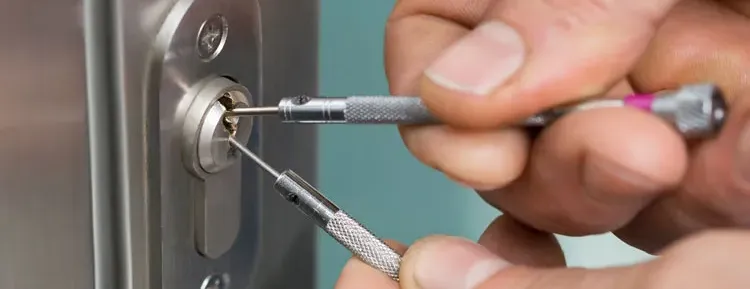
Knowing the difference between a locksmith and a security technician helps property owners choose the right pro for physical or electronic security. This guide breaks down what each specialist does, where their skills overlap, and when to call a locksmith versus a security locksmith to protect doors, access points, and networked systems. You’ll learn core locksmith services like emergency lockout response, rekeying, and smart lock installation, alongside the electronic focus of security technicians who install alarms, CCTV, and access control. We map common scenarios, compare tools and training, and explain how working together gives a stronger security position. Read on for clear, practical guidance on lock repair, smart lock setup, alarm installation, or building an integrated security plan.
What Does a Locksmith Do? Exploring Locksmith Duties and Expertise
A locksmith is a practical security professional who specialises in mechanical and electromechanical access hardware. They secure doors, safes, vehicles, and other physical entry points by cutting and duplicating keys, rekeying cylinders, repairing or replacing locks, and fitting new hardware. These actions change how mechanical components allow or deny access, restoring controlled entry, reducing risk from lost or stolen keys, and enabling upgrades to stronger locks or compatible smart modules. The section below lists common locksmith services and shows how fast response resolves immediate access problems.
At Lost Key Locksmith we provide full locksmithing services, including emergency lockouts, lock repair, and installation of both traditional and smart locks. We focus on prompt emergency response and practical physical security advice. This practical approach shows when a dedicated locksmith is the right call. Read on for core services and real world examples of emergency and preventive work.
Which Services Are Provided by Locksmiths?
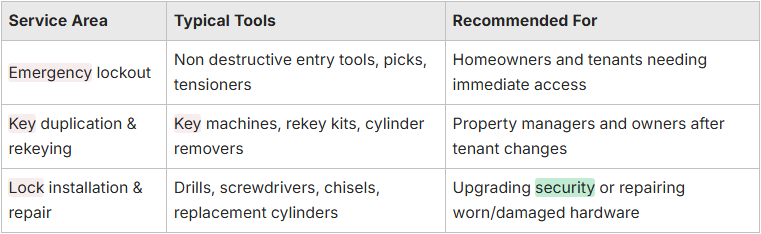
Locksmiths offer a range of practical services to secure physical access and restore entry when problems occur. Typical services include emergency lockout response to regain access quickly; key duplication and rekeying to control who has keys; lock installation and repair for deadbolts and commercial hardware; safe servicing and combination changes; and automotive lock work for lost or damaged car keys. Increasingly, locksmiths also install and troubleshoot smart locks by integrating electronic modules with door hardware. For example: a tenant locked out after hours regained access within an hour after a locksmith performed non destructive entry and replaced a failing cylinder.
- Emergency lockout response: fast, non destructive entry and on site fixes.
- Key duplication and rekeying: regain control after lost keys or tenant turnover.
- Lock installation and repair: upgrade or restore deadbolts, cylinders, and door hardware.
- Safe servicing and automotive locks: specialised work for valuables and vehicles.
- Smart lock installation: fitting hardware and connecting electronic modules.
These services are the practical core of locksmith work and are often the quickest way to restore secure access before considering larger electronic systems.
How Do Locksmiths Handle Traditional and Smart Locks?
Workflows vary between purely mechanical installs and smart lock programming, though the skills are complementary. For conventional deadbolts and mortise locks, locksmiths focus on alignment, precise drilling, correct cylinder sizing, and secure mounting for long term mechanical reliability. Installing a smart lock still requires proper physical fit. Locksmiths handle the hardware, battery access, and secure mounting, then set up the electronic module, pairing via Bluetooth or Wi Fi, creating user credentials, and checking interoperability with existing door hardware. Troubleshooting often combines mechanical adjustments (to remove binding) and electronic resets or firmware checks, so hybrid expertise is valuable.
Understanding these dual workflows helps you decide whether you need a locksmith who also handles electronic pairing or whether a coordinated approach with a security technician is better for broader system integration. Next, we cover the electronic responsibilities of security technicians.
What Are the Responsibilities of a Security Technician? Understanding Security Technician Roles
Security technicians focus on electronic security systems: installing, configuring, and integrating alarms, CCTV cameras, sensors, and networked access control platforms. Their work centres on system design, cabling, power management, network configuration, and software setup to enable remote monitoring, alerts, and centralised control. Technicians make sure components communicate, manage user credentials and permissions in software, and keep logs and monitoring services working to support incident response. The section below outlines common electronic systems and installation considerations.
Lost Key Locksmith concentrates on physical access and hardware, while security technicians handle the electronic systems that monitor and control those access points. Knowing this distinction clarifies when a locksmith can provide a complete solution and when collaboration with a technician is the right move. The next section details common electronic systems and typical installers or maintainers.
Which Electronic Security Systems Do Security Technicians Install and Maintain?
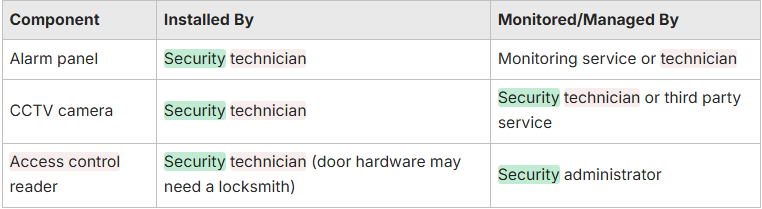
Security technicians work with several classes of electronic systems that protect and monitor properties. Alarm panels and sensors form the backbone of intrusion detection, linking door and motion sensors to a control unit and optional monitoring service. CCTV and surveillance equipment record video and require careful camera placement, lighting evaluation, and network bandwidth planning. Access control systems use card readers, keypads, or mobile credentials tied to controllers and management software, often interfacing with door strikes or electric locks. Environmental sensors and smart alarms add coverage for fire, flood, and other hazards and may connect to monitoring stations.
- Alarm panels and wired/wireless sensors: detection, zoning, and monitoring setup.
- CCTV cameras and recorders: camera placement, field of view, and storage planning.
- Access control readers and controllers: credential management and door release hardware.
The short table below shows who usually installs and manages each component, and highlights where locksmiths and technicians work together.
How Do Security Technicians Integrate Access Control and Surveillance?
Integrating access control with surveillance requires both door level hardware alignment and software coordination. Technicians build credential databases, set schedules and permission levels, and link door event logs to CCTV timestamps so access events are verifiable on camera. Physical interfaces, such as electric strikes, maglocks, or smart lock modules, often require a locksmith to prepare the door and confirm hardware compatibility before technicians connect controllers. Common integration tasks include triggering cameras on alarm events and synchronising access logs with recorded footage for reliable audit trails.
Knowing these touchpoints makes it clear when a security technician should coordinate with a locksmith to ensure tamper resistant installations and a consistent user experience. The next section contrasts core differences in tools, training, and use cases.
What Are the Key Differences Between Locksmiths and Security Technicians?
Both professions aim to protect people and property, but they focus on different layers. Locksmiths specialise in mechanical and electromechanical door hardware, while security technicians specialise in electronic systems, networking, and monitoring. Their toolkits differ. Locksmiths use cylinder tools, picks, and key machines, while technicians use multimeters, network analysers, DVR/NVR tools, and configuration software. Training paths also vary: locksmiths build mechanical expertise and emergency entry skills, while technicians develop networking and software integration abilities. The table below summarises responsibilities, typical tasks, main tools, and ideal use cases for each role.
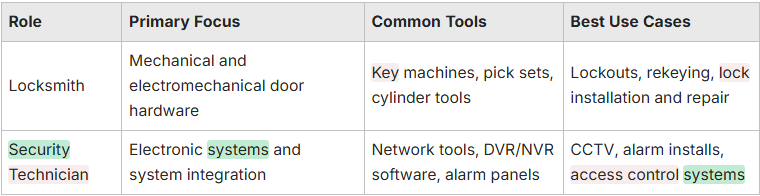
This overview shows where each specialty adds the most value and where their skills intersect. The following subsections unpack typical duty differences and the tools that set them apart.
How Do Locksmith Duties Differ from Security System Installation?
Locksmith duties typically include rekeying cylinders, replacing or repairing physical locks, non destructive entry, and fitting door hardware so mechanical components operate reliably. These tasks directly change who can open a lock by mechanical means. Security system installation, by contrast, places sensors and cameras, configures control panels, and establishes monitoring workflows that report events without altering mechanical access paths. When technicians install electric locking hardware, tasks overlap and require close coordination to ensure a secure physical electronic interface and dependable fail safe behaviour.
Understanding these differences helps homeowners prioritise urgent mechanical fixes versus planning longer term electronic coverage. The next section explains the specific tools and skills that distinguish each profession.
What Tools and Skills Distinguish Locksmiths from Security Technicians?
Different toolkits and skill sets define each discipline. Locksmiths master mechanical diagnostics, cylinder pinning, lock alignment, and non destructive entry techniques; their tools include key cutting machines, pick sets, rekey kits, torque wrenches, and deadbolt installation equipment. Security technicians bring networking, systems integration, and surveillance optimisation skills; they use cable testers, multimeters, configuration software, and video management systems. Cross trained specialists who install smart locks combine both toolsets to fit hardware correctly and configure electronic credentials. Knowing these differences helps property owners hire the right professional faster.
These distinctions lead naturally into practical hiring guidance and scenarios that clarify when to call each pro.
When Should You Hire a Locksmith or a Security Technician? Practical Scenarios and Guidance
Choose based on the immediate problem and your long term security goals. Call a locksmith first for lost keys, emergency lockouts, broken key extraction, rekeying after tenant turnover, or upgrading mechanical door hardware. Call a security technician for alarm installations, CCTV system design, continuous monitoring, networked access control across multiple doors, and integrations that need centralised credential management. Mixed projects, for example, installing an electric strike with centralised credentialing, usually benefit from both professionals coordinating to ensure mechanical reliability and electronic control.
In Which Situations Is a Locksmith the Right Professional?
Locksmiths are the right first responders for urgent and routine issues involving physical access and door hardware. Common situations include emergency lockouts needing fast, non destructive entry; broken key extraction from cylinders; rekeying after lost keys or tenant changes; replacing or upgrading worn locks and cylinders; and installing or servicing safes. These practical interventions restore or reinforce physical entry control and often resolve immediate safety concerns.
- Emergency lockout and non destructive entry.
- Broken key extraction and on site mechanical repairs.
- Rekeying after tenant changes or suspected key compromise.
- Upgrading locks to meet security needs.
Keep these use cases in mind when access or mechanical hardware is the core issue.
When Is It Best to Call a Security Technician?
Call a security technician when detection, monitoring, or integrated electronic control are the goals rather than mechanical access alone. Typical scenarios include installing a professionally monitored alarm system, deploying CCTV for continuous surveillance and evidence capture, setting up networked access control across multiple doors with centralised user management, and adding environmental sensors for fire, flood, or other hazards. Security technicians design systems that deliver alerts, logs, and remote management. This is essential for properties that need active monitoring or centralised credential administration.
- Professional alarm installation with monitoring options.
- CCTV systems designed for coverage, recording, and retention.
- Networked access control with centralised credential and audit management.
Often the best outcome comes from a technician and a locksmith working together so doors and electronic interfaces operate reliably.
How Do Locksmiths and Security Technicians Collaborate for Comprehensive Security Solutions?
When locksmiths and security technicians collaborate, you get a cohesive system that pairs sturdy physical hardware with dependable electronic monitoring. Good collaboration starts with joint planning: locksmiths evaluate door strength, frame reinforcement, and suitable hardware while technicians map sensor placement, wiring runs, and control locations so electronics fit the physical constraints. During installation, locksmiths confirm hardware compatibility with electric strikes or smart lock modules and technicians handle controllers, credential provisioning, and software integration. The end result: mechanically sound doors whose events are electronically logged and monitored for anomalies.
Lost Key Locksmith supports integrated projects by providing physical hardware expertise, emergency response planning, and door prep guidance while coordinating with electronic installers to ensure smooth operation between locks and monitoring systems.
What Are the Benefits of Integrated Physical and Electronic Security?
Layering physical and electronic security improves deterrence, detection, and accountability. Strong locks, reinforced frames, and correctly installed cylinders lower the risk of forced entry, while electronic systems add detection, recording, and alerting for faster response and better post incident investigation. Integration creates audit trails that link credential use to camera footage and door events, improving incident reconstruction and internal accountability. Layered security also offers redundancy: if one element fails, others still protect the site, and coordinated planning closes gaps attackers might exploit.
- Better accountability with access logs tied to surveillance.
- Stronger deterrence by combining robust hardware and visible monitoring.
- Redundancy and resilience when mechanical and electronic measures back each other.
These advantages explain why many projects require both locksmith and technician expertise rather than choosing just one approach.
How Does Lost Key Locksmith Support Holistic Security Needs?
Lost Key Locksmith delivers practical physical security services and consultative guidance that complement electronic system design. Our core locksmithing services, including emergency lockouts, lock repair, and installation of both traditional and smart locks, make sure door hardware is ready for electronic interfaces and that emergency plans consider both mechanical and monitored contingencies. On collaborative jobs we work with electronic installers to confirm strikes, maglocks, and smart lock modules are fitted to compliant doors and support credential workflows and emergency override paths.
- Physical hardware expertise to ensure compatibility with electronic controllers.
- Emergency response planning that preserves secure egress and access control.
- Consultative recommendations balancing mechanical durability with electronic flexibility.
This partnership first approach reduces installation mismatches, speeds project timelines, and helps physical and electronic layers operate together for reliable, maintainable security.
Why Choose Lost Key Locksmith for Your Physical and Electronic Security Needs?
Lost Key Locksmith combines traditional locksmith craftsmanship with smart lock know how and practical security consulting to cover a wide range of physical security needs. We offer mechanical and electronic lock expertise, rapid emergency response for urgent lock issues, full security consultations that assess access points, and adaptability to technologies like smart locks and access modules. That mix of immediate response services and forward looking installation experience helps property owners secure their sites now while planning for future electronic integration. Below is a concise summary of our core strengths.
What Expertise Does Lost Key Locksmith Offer in Modern Security?
We blend mechanical craftsmanship with smart lock experience to meet modern security demands. Lost Key Locksmith installs and services traditional deadbolts and commercial cylinders, and we handle smart lock modules that require pairing and basic credential setup. Our consultations focus on physical access points, hardware selection, and door preparation for integrated systems. We prioritise quick emergency response to restore secure access and ensure hardware choices work with broader electronic control strategies.
- Mechanical and electronic lock expertise for a variety of door hardware.
- Security consultations that focus on access points and integration needs.
- Prompt emergency response to restore safe access when incidents occur.
These capabilities make Lost Key Locksmith a practical partner when you need both mechanical reliability and smart lock integration.
How Can Lost Key Locksmith Assist with Emergency and Smart Lock Services?
Our emergency and smart lock services cover both immediate needs and planned upgrades. For emergencies we provide fast lockout response, non destructive entry, and on site lock repair to minimise downtime and secure premises. For planned work we install smart locks, program basic credentials, and prepare door hardware so technicians can later integrate locks into centralised access control platforms if required. By offering reactive and proactive services, Lost Key Locksmith helps clients bridge the gap between mechanical strength and electronic flexibility.
- 24/7 style emergency response focused on non destructive solutions.
- Smart lock installation and initial programming to support future integration.
- Consultative advice to align hardware choices with monitoring and access control strategies.
If you need safe access restored now and want a clear path to future integration, Lost Key Locksmith’s practical, consultative approach gives you that flexibility.
Read More

How to Choose the Best Type of Locks for Gates
When we're picking the best gate locks, we need to think about how much protection we want, whether the lock will actually work with our gate, how often we'll be using it, and how well it'll handle our weather. The safest options we can go with include heavy-duty deadbolts, high-security padlocks, electronic smart locks, and magnetic locks that can handle people trying to mess with them or force their way through.
How to Unlock a Bathroom Door
Being locked out of your bathroom is one of those uniquely frustrating experiences that seems minor until it's happening to you. Maybe you've got a toddler who's discovered the fascinating lock button and pushed it on their way out, or perhaps you accidentally hit the privacy lock yourself and shut the door before realizing your mistake. Whatever the reason, you're stuck on the wrong side of the door and you need to get in.

What to Know About Magnetic Locks
Thinking about using a magnetic lock for your home or business? You’re not alone—maglocks are becoming a go-to choice for modern security. They’re simple, strong, and easy to use, but like any system, they come with a few things to consider.


